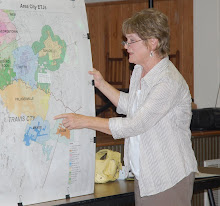
Thanks to Texas 391 Commission Alliance blog
391texas.blogspot.com
for publishing our report on the presentation by Dan Byfield, Mayor Mae Smith, and Ralph Snyder to the Coupland Civic Organization meeting. Our post was "Dan Byfield on 391 Commissions, TTC." from April 4.
Visit the 391 Commission blog for continuing news about all nine Texas 391 Commissions and the "coordination" process that requires state agencies, including TxDOT to coordinate their plans and projects with local communities that are protected by 391 Commissions.
It is the Eastern Central Texas Sub-Regional Planning Commission, the 391 in Bell County, that has held up the Final Environmental Impact Statement for TTC-35 in the Federal Highway Administration by formally demanding a supplemental study for the 26 required environmental issues that TxDOT did not address in the original Draft Environmental Impact statement.
Bravo, guys!
Showing posts with label 391 Commissions. Show all posts
Showing posts with label 391 Commissions. Show all posts
Wednesday, April 8, 2009


Saturday, April 4, 2009
Dan Byfield on "391" Commissions, TTC
At its March 30 meeting, the Coupland Civic Organization heard a presentation from Dan Byfield, president of the American Land Foundation, a national property rights organization. Along with his wife Margaret, who founded another property rights group Stewards of the Range, Byfield was instrumental in forming the “391 Commissions” in Texas to fight the Trans-Texas Corridor.
The first “391” was founded in 2007 in Bell County—the East Central Texas Sub-Regional Planning Commission (ECTSRPC). One of its members is the City of Holland, and also speaking at the meeting were Mae Smith, mayor of Holland and president of the ECTSRPC, and Ralph Snyder, a Holland businessman and a director of the ECTSRPC. Snyder and his wife Marcia helped found the ECTSRPC.
Coordination
Byfield recounted that two-and-a-half years ago, he discovered a requirement in a Texas statute that TxDOT and other state agencies must “coordinate” their planning with local planning commissions. The requirement is in Chapter 391 of the Texas Local Government Code, hence, the name “391 Commissions.” He said, “I told Ralph we needed to start a commission. Ralph started meeting with officials in his area [eastern Bell County], formed the commission, and state agencies started coordinating with this commission.”
There must be two incorporated cities, two counties, or one city and one county to start a “391,” and then other entities such as school districts can join. The ECTSRPC began with Holland, Bartlett, Little River-Academy, and Rogers and then added their school districts.
TxDOT at bay--environmental process
Byfield said, “For two years now we have held TxDOT at bay. There’s no Corridor through our jurisdiction. We put a 30-mile-hole through the Corridor; they’re not going to build a road with a 30-mile gap.” The ECTRPC and Buckholts residents became concerned that TxDOT might bypass Bell County by going farther east through Buckholts, so Buckholts joined the ECTRPC, thus gaining its protection.
The ECTSRPC has stopped the Corridor through the environmental process. TxDOT cannot proceed until the Final Environmental Impact Statement (FEIS) for Tier 1 is out. Snyder said, “There were 26 items that TxDOT was obligated to do that they didn’t do. We asked for a supplement to cover these items.”
The ECTSRPC made a formal demand that TxDOT stop the development of the Corridor and restudy it in a supplemental environmental study. The FEIS is still at the Federal Highway Administration, and Snyder says, “If they don’t approve it in the next couple of months, they have to start over.”
Mayor Smith and Ralph Snyder on Texas T-bone high-speed rail
Mayor Smith asked, “Why destroy the Blackland that you cannot replace? Stand up for your land! A statute is on the books that they have to listen to us. When we call, they come to Holland, Texas. We are 45 percent of Bell County.”
She also is concerned about the latest high-speed rail proposal, which is called the Texas T-Bone. A line will run through the state north to south, with a line coming toward it from Bryan that “T’s” into the north-south line in the Temple area. This line would damage the rural areas of Bell County represented by the ECTSRPC.
About high-speed rail, Snyder asked, “Who gets to pay for the planning, for the studies, for the state’s loan to foreign companies, for the decreased value of land on each side of it? We do!”
The ECTSRPC asked for our support in their fight against high-speed rail. They appreciated that the Coupland area had fought the previous high-speed rail proposal, and also that we were among the early opponents of the Corridor.
Legislative attempts to abolish "391's"
About possible attempts in the Legislature to abolish the “391’s,” Byfield said, “There is coordination language in federal statute as well. The National Environmental Policy Act has coordination in it.” Also, he believes the state “can’t do away with the statute because the COG’s [Councils of Government] were created under it.”
To form a Sub-Regional Planning Commission, the cities and counties must be in the same Council of Government. Williamson is not in the COG with Bell County; it is in the Capital Area COG, along with the counties of Bastrop, Blanco, Burnet, Caldwell, Fayette, Hays, Lee, Llano, and Travis.
Supporting "391's"
The speakers were asked, since Coupland is not incorporated, how we can participate in the Sub-Regional Planning Commission process. Snyder mentioned supporting the American Land Foundation and Stewards of the Range: “These two foundations operate on donations.” Mayor Smith added, “Support the commissions that are out there.” Currently, there are nine in Texas. News and descriptions of all of them are at http://www.391texas.blogspot.com/.
Attendees were given copies of Standing Ground, the publication of Stewards of the Range and American Land Foundation. You can view it online at http://www.stewards.us/. The site of American Land Foundation is http://www.amland.us/.
The first “391” was founded in 2007 in Bell County—the East Central Texas Sub-Regional Planning Commission (ECTSRPC). One of its members is the City of Holland, and also speaking at the meeting were Mae Smith, mayor of Holland and president of the ECTSRPC, and Ralph Snyder, a Holland businessman and a director of the ECTSRPC. Snyder and his wife Marcia helped found the ECTSRPC.
Coordination
Byfield recounted that two-and-a-half years ago, he discovered a requirement in a Texas statute that TxDOT and other state agencies must “coordinate” their planning with local planning commissions. The requirement is in Chapter 391 of the Texas Local Government Code, hence, the name “391 Commissions.” He said, “I told Ralph we needed to start a commission. Ralph started meeting with officials in his area [eastern Bell County], formed the commission, and state agencies started coordinating with this commission.”
There must be two incorporated cities, two counties, or one city and one county to start a “391,” and then other entities such as school districts can join. The ECTSRPC began with Holland, Bartlett, Little River-Academy, and Rogers and then added their school districts.
TxDOT at bay--environmental process
Byfield said, “For two years now we have held TxDOT at bay. There’s no Corridor through our jurisdiction. We put a 30-mile-hole through the Corridor; they’re not going to build a road with a 30-mile gap.” The ECTRPC and Buckholts residents became concerned that TxDOT might bypass Bell County by going farther east through Buckholts, so Buckholts joined the ECTRPC, thus gaining its protection.
The ECTSRPC has stopped the Corridor through the environmental process. TxDOT cannot proceed until the Final Environmental Impact Statement (FEIS) for Tier 1 is out. Snyder said, “There were 26 items that TxDOT was obligated to do that they didn’t do. We asked for a supplement to cover these items.”
The ECTSRPC made a formal demand that TxDOT stop the development of the Corridor and restudy it in a supplemental environmental study. The FEIS is still at the Federal Highway Administration, and Snyder says, “If they don’t approve it in the next couple of months, they have to start over.”
Mayor Smith and Ralph Snyder on Texas T-bone high-speed rail
Mayor Smith asked, “Why destroy the Blackland that you cannot replace? Stand up for your land! A statute is on the books that they have to listen to us. When we call, they come to Holland, Texas. We are 45 percent of Bell County.”
She also is concerned about the latest high-speed rail proposal, which is called the Texas T-Bone. A line will run through the state north to south, with a line coming toward it from Bryan that “T’s” into the north-south line in the Temple area. This line would damage the rural areas of Bell County represented by the ECTSRPC.
About high-speed rail, Snyder asked, “Who gets to pay for the planning, for the studies, for the state’s loan to foreign companies, for the decreased value of land on each side of it? We do!”
The ECTSRPC asked for our support in their fight against high-speed rail. They appreciated that the Coupland area had fought the previous high-speed rail proposal, and also that we were among the early opponents of the Corridor.
Legislative attempts to abolish "391's"
About possible attempts in the Legislature to abolish the “391’s,” Byfield said, “There is coordination language in federal statute as well. The National Environmental Policy Act has coordination in it.” Also, he believes the state “can’t do away with the statute because the COG’s [Councils of Government] were created under it.”
To form a Sub-Regional Planning Commission, the cities and counties must be in the same Council of Government. Williamson is not in the COG with Bell County; it is in the Capital Area COG, along with the counties of Bastrop, Blanco, Burnet, Caldwell, Fayette, Hays, Lee, Llano, and Travis.
Eminent domain
Regarding eminent domain in this legislative session, Byfield said there are eight bills and three constitutional amendments filed. He said there are some “good bills, supported by the Texas Farm Bureau, but they aren’t supported by the governor. We don’t know that we will see good legislation. This session is very important for rural Texas.”Supporting "391's"
The speakers were asked, since Coupland is not incorporated, how we can participate in the Sub-Regional Planning Commission process. Snyder mentioned supporting the American Land Foundation and Stewards of the Range: “These two foundations operate on donations.” Mayor Smith added, “Support the commissions that are out there.” Currently, there are nine in Texas. News and descriptions of all of them are at http://www.391texas.blogspot.com/.
Attendees were given copies of Standing Ground, the publication of Stewards of the Range and American Land Foundation. You can view it online at http://www.stewards.us/. The site of American Land Foundation is http://www.amland.us/.
Saturday, March 21, 2009
Dan Byfield, national property rights advocate, to speak in Coupland March 30
In the comment to yesterday's post, Eminent domain bill set for hearing March 25, Chris writes about the problems encountered by property owners with issues other than condemnation for transportation, such as energy and right-of-way. The Coupland Civic Organization is hosting a national property rights advocate on Monday, March 30, whose organization is involved in all these issues.
Dan Byfield, president of the American Land Foundation, a national property rights organization, will speak to the Coupland Civic Organization on Monday, March 30, in the Fellowship Hall of St. Peter’s Church of Coupland. The Coupland Civic Organization will host a spaghetti supper at 6:30 p.m.; the program will begin at 7 p.m.
Byfield will discuss the “391 Commissions” that he has formed in Texas to fight projects like the Trans-Texas Corridor. He says, “The American Land Foundation and Stewards of the Range have joined efforts to teach local communities how to fight for and protect private property through a strategy known as ‘Coordination.’ Utilizing federal and state land use statutes, Coordination gives local units of government the power to bring government regulatory agencies to their table.”
These agencies are required by law to “coordinate,” meaning that they have to give notice of any plans or projects they are considering to the local unit of government, such as a “391 Commission.” The agency must take local plans and desires into account when making its plans. “The strongest aspect of Coordination,” Byfield explains, “is the government agencies have to make their plans, as closely as possible, consistent with the local plans.”
The first “391 Commission” is the Eastern Central Texas Sub-Regional Planning Commission in Bell County, which was founded in 2007 to fight the Trans-Texas Corridor. Byfield says, “In 2008, we went to over 20 locations utilizing Coordination, with nine in Texas. This year, we expect to get to over 40 communities implementing Coordination nationwide for every type of issue, including Endangered Species Act listings, water rights, zoning, transportation, conservation easements, oil and gas exploration, and dozens of other land use issues.”
In addition to discussing helping local communities fight for their property rights, Byfield will also speak on related legislative issues, such as eminent domain.
Dan Byfield has worked on property rights, water, and natural resource issues as a legislative staff member. He has lobbied on behalf of agriculture for the Texas Farm Bureau. He did legislative work on property rights matters in New Mexico, Texas, and Washington for the Farm Credit Bank of Texas. In 1993, he formed the American Land Foundation and serves as its president. The American Land Foundation assists landowners and other property rights organizations nationwide.
Dan Byfield, president of the American Land Foundation, a national property rights organization, will speak to the Coupland Civic Organization on Monday, March 30, in the Fellowship Hall of St. Peter’s Church of Coupland. The Coupland Civic Organization will host a spaghetti supper at 6:30 p.m.; the program will begin at 7 p.m.
Byfield will discuss the “391 Commissions” that he has formed in Texas to fight projects like the Trans-Texas Corridor. He says, “The American Land Foundation and Stewards of the Range have joined efforts to teach local communities how to fight for and protect private property through a strategy known as ‘Coordination.’ Utilizing federal and state land use statutes, Coordination gives local units of government the power to bring government regulatory agencies to their table.”
These agencies are required by law to “coordinate,” meaning that they have to give notice of any plans or projects they are considering to the local unit of government, such as a “391 Commission.” The agency must take local plans and desires into account when making its plans. “The strongest aspect of Coordination,” Byfield explains, “is the government agencies have to make their plans, as closely as possible, consistent with the local plans.”
The first “391 Commission” is the Eastern Central Texas Sub-Regional Planning Commission in Bell County, which was founded in 2007 to fight the Trans-Texas Corridor. Byfield says, “In 2008, we went to over 20 locations utilizing Coordination, with nine in Texas. This year, we expect to get to over 40 communities implementing Coordination nationwide for every type of issue, including Endangered Species Act listings, water rights, zoning, transportation, conservation easements, oil and gas exploration, and dozens of other land use issues.”
In addition to discussing helping local communities fight for their property rights, Byfield will also speak on related legislative issues, such as eminent domain.
Dan Byfield has worked on property rights, water, and natural resource issues as a legislative staff member. He has lobbied on behalf of agriculture for the Texas Farm Bureau. He did legislative work on property rights matters in New Mexico, Texas, and Washington for the Farm Credit Bank of Texas. In 1993, he formed the American Land Foundation and serves as its president. The American Land Foundation assists landowners and other property rights organizations nationwide.
Wednesday, November 26, 2008
Ralph and Marcia Snyder receive award
 For posts about Sal Costello and David Stall, see previous two posts.
Left to right: Fred Grant, President, Stewards of the Range
Marcia Snyder
Ralph Snyder
Ralph and Marcia Snyder, of Holland, Texas, have been fighting against the Corridor ever since it was authorized in 2003. In 2007, they were instrumental in forming the Eastern Central Texas Sub-Regional Planning Commission (ECTSRPC), the first of the 391 commissions that are forming state-wide to protect their areas against the Corridor. They recently received the “Spirit of Liberty” award at the annual convention of Stewards of the Range and the American Land Foundation held in Austin. This award is given to individuals who work tirelessly to protect private property and their local communities from government intrusion.
Mae Smith, mayor of Holland and president of the ECTSRPC said of the Snyders, “Without their knowledge and dedication to our community, we would never have known what to do or how to fight the Texas Department of Transportation’s plans to destroy our community.”
The ECTSRPC has forced TxDOT to coordinate their plans with the commission during several meetings. The commission also has met with the Environmental Protection Agency, the Natural Resource Conservation Service, Texas Parks and Wildlife, and the Texas Commission on Environmental Quality.
The Stewards of the Range and the American Land Foundation are property rights organizations leading the fight against the Corridor.
Tuesday, October 21, 2008
Learn how to use 391 coordination strategy to stop TTC
Dan and Margaret Byfield have been having a great deal of success in helping to form 391 Planning Commissions along the path of the Trans-Texas Corridor. The first one, Bell County’s Eastern Central Texas Sub-Regional Planning Commission, is in the path of TTC-35 and has stalled the release of the TTC-35 Final Environmental Impact Statement. The other 391 commissions are along the path of the Corridor through East Texas.
The commissions are based on section 391 of the Texas Municipal Code that allows local communities to organize to demand coordination from larger entities who are threatening their areas. Now, the Byfields are hosting the Call America 2008 Conference in Austin, November 13-15 to show others how to implement this “coordination” strategy.
For more info and to register, go to
www.stewards.us/conference/callconf_08/call_home.html
The commissions are based on section 391 of the Texas Municipal Code that allows local communities to organize to demand coordination from larger entities who are threatening their areas. Now, the Byfields are hosting the Call America 2008 Conference in Austin, November 13-15 to show others how to implement this “coordination” strategy.
For more info and to register, go to
www.stewards.us/conference/callconf_08/call_home.html
Subscribe to:
Posts (Atom)