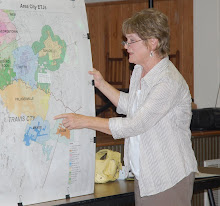
David Leibowitz (D-San Antonio) has pre-filed HB 11 which would repeal any authority to create and/or operate the Trans-Texas Corridor.
The link to HB 11 is
http://www.capitol.state.tx.us/Search/DocViewer.aspx?K2DocKey=odbc%3a%2f%2fTLO%2fTLO.dbo.vwCurrBillDocs%2f81%2fR%2fH%2fB%2f00011%2f1%2fB%40TloCurrBillDocs&QueryText=HB+11&HighlightType=1
This is very long, and if it doesn’t work, go to Texas Legislature Online at
www.capitol.state.tx.us
and enter HB 11 in the search box.
HB 3588 in 2003 contained the enabling legislation for the TTC. This new HB 11 would take away that authority to create the TTC. No entity, either TxDOT or Cintra, would be able to create the TTC.
An interesting question: what would happen with the agreement with Cintra if the TTC is killed by the legislature? As I understand it, the most recent contract between TxDOT and Cintra on the TTC is only a planning contract. The $3.5 million contract signed in 2005 is an agreement for Cintra to do a master plan that would show how to finance and build TTC-35.
If HB 11 or similar legislation succeeds in killing the TTC, I assume that Texas would owe Cintra only the $3.5 million for the planning contract. We'll see how it all unfolds during the upcoming session.
Wednesday, December 31, 2008


Tuesday, December 16, 2008
Coupland grain elevator tower--now you don't.

This photo is too dark to tell. I'll try to get a lighter one. The sunrise is still pretty.
Trust me, the tower is gone.
Coupland grain elevator tower--now you see it . . .
 For many decades, the tower of the grain elevator along the railroad tracks graced the Coupland skyline.
 Seen at sunrise, the tower is the triangular structure to the left of St. Peter's Church.
The elevators were recently torn down.
Monday, December 15, 2008
National Review article advises Obama to do like Rick Perry
The topic of Texas transportation and the stimulus package have been commented upon in National Review in an article called Wrong Road on Transportation, by Sam Staley and Adrian Moore. The general drift of the first part of the article is generally OK, about thinking of new and better ways to do transportation and using the stimulus funds in the best way to create needed jobs.
Then, they lurch right off the tracks when they come to specific recommendations.
Full article:
http://nrd.nationalreview.com/article/?q=MTk5OTgzMDllMjlhNzA5ZTM2OTI1NzFlNDEzODY3ZDk=
Then, they lurch right off the tracks when they come to specific recommendations.
Fortunately, we have the tools and the incentive to embrace the innovation necessary to reestablish the U.S. as a world leader in infrastructure investment. Many of President-elect Obama’s transportation advisers are poised to embrace many of these innovations, if they are appointed to key posts in the administration. Central to the reform efforts will be an expanded
role for technology and the private sector in providing new, high-quality infrastructure.Hundreds of billions of dollars are available worldwide for infrastructure investments in the U.S., an unintended but happy side-effect of the “flight to quality” brought about by the collapse of world financial markets. Experience in China, Australia, India, France, Spain, and elsewhere has demonstrated the importance of letting the private sector take the lead in proposing, developing, and implementing these solutions through long-term agreements with governments called public-private partnerships (PPPs).
Transportation policy may be one area where an Obama administration will leave a positive legacy for the nation and its cities. While Republican governors such as Rick Perry in Texas and Mitch Daniels in Indiana have staked out ambitious and politically courageous positions supporting PPPs . . .I say that fortunately, I hope, the Obama administration will not take the advice of National Review, and will not go down the road of Gov. 39%, attempting to use eminent domain to take land throughout the country for the benefit of foreign corporations such as Cintra.
Full article:
http://nrd.nationalreview.com/article/?q=MTk5OTgzMDllMjlhNzA5ZTM2OTI1NzFlNDEzODY3ZDk=
Saturday, December 13, 2008
David Brooks--don't use the stimulus to encourage sprawl
David Brooks has a column in the New York Times warning about the "new" Obama stimulus funds being used to further the "old" transportation modes, rather than developing new ways of transportation to help the new suburban centers that are developing and the urban centers that are being revitalized.
http://www.nytimes.com/2008/12/09/opinion/09brooks.html
He speaks of the recent population dispersal, where "Forty-three million people moved every year, and basically they moved outward — from inner-ring suburbs to far-flung exurbs on the metro fringe."
He says that these people now realize they want closer community and social contacts, leading to a new trend: "Meeting places are popping up across the suburban landscape. There are restaurant and entertainment zones, mixed-use streetscape malls, suburban theater districts, farmers’ markets and concert halls. In addition, downtown areas in places like Charlotte and Dallas are reviving . . .
"If, indeed, we are going to have a once-in-a-half-century infrastructure investment, it would be great if the program would build on today’s emerging patterns. It would be great if Obama’s spending would actually encourage the clustering and leave a legacy that would be visible and beloved 50 years from now."
"To take advantage of the growing desire for community, the Obama plan would have to do two things. First, it would have to create new transportation patterns. . . Second, the Obama stimulus plan could help localities create suburban town squares."
"But alas, there’s no evidence so far that the Obama infrastructure plan is attached to any larger social vision. In fact, there is a real danger that the plan will retard innovation and entrench the past. . . . The quickest thing to do is simply throw money at things that already exist."
"Before the recession hit, we were enjoying a period of urban and suburban innovation. We could have been on the verge of a transportation revolution. It looks as if the Obama infrastructure plan may freeze that change, not fuel it."
http://www.nytimes.com/2008/12/09/opinion/09brooks.html
He speaks of the recent population dispersal, where "Forty-three million people moved every year, and basically they moved outward — from inner-ring suburbs to far-flung exurbs on the metro fringe."
He says that these people now realize they want closer community and social contacts, leading to a new trend: "Meeting places are popping up across the suburban landscape. There are restaurant and entertainment zones, mixed-use streetscape malls, suburban theater districts, farmers’ markets and concert halls. In addition, downtown areas in places like Charlotte and Dallas are reviving . . .
"If, indeed, we are going to have a once-in-a-half-century infrastructure investment, it would be great if the program would build on today’s emerging patterns. It would be great if Obama’s spending would actually encourage the clustering and leave a legacy that would be visible and beloved 50 years from now."
"To take advantage of the growing desire for community, the Obama plan would have to do two things. First, it would have to create new transportation patterns. . . Second, the Obama stimulus plan could help localities create suburban town squares."
"But alas, there’s no evidence so far that the Obama infrastructure plan is attached to any larger social vision. In fact, there is a real danger that the plan will retard innovation and entrench the past. . . . The quickest thing to do is simply throw money at things that already exist."
"Before the recession hit, we were enjoying a period of urban and suburban innovation. We could have been on the verge of a transportation revolution. It looks as if the Obama infrastructure plan may freeze that change, not fuel it."
Burka comments on Hutchison poll
At Texas Monthly, Paul Burka comments on the poll showing KBH ahead of Perry by 24% among Republican primary voters.
http://www.texasmonthly.com/blogs/burkablog/?p=2162#comments
Among other things, he notes:
"What is surprising — according to the Hutchison camp — is that his support among Republican primary voters is down 10% since his 2006 race. . . . When you’re down by 24 points, you can’t just run on your record. Perry is going to have to engage in a big-time negative campaign."
A commenter to Burka's post believes:
"Any credible Democrat would beat Perry in the next general election. He has virtually no independent support and is damaged goods within the GOP. . . . The state is not working. Perry cannot win reelection. KBH is the best hope of keeping the seat in GOP hands."
And it's still 2008. We seem to have entered the land of the perpetual campaign. Shaping up to be good entertainment, in the manner of the soap opera.
http://www.texasmonthly.com/blogs/burkablog/?p=2162#comments
Among other things, he notes:
"What is surprising — according to the Hutchison camp — is that his support among Republican primary voters is down 10% since his 2006 race. . . . When you’re down by 24 points, you can’t just run on your record. Perry is going to have to engage in a big-time negative campaign."
A commenter to Burka's post believes:
"Any credible Democrat would beat Perry in the next general election. He has virtually no independent support and is damaged goods within the GOP. . . . The state is not working. Perry cannot win reelection. KBH is the best hope of keeping the seat in GOP hands."
And it's still 2008. We seem to have entered the land of the perpetual campaign. Shaping up to be good entertainment, in the manner of the soap opera.
Friday, December 12, 2008
Kay Bailey Hutchison starts out with big advantage over Gov. 39%
KC Jones, political director of Texans for Kay, reports that a statewide poll conducted right after Sen. Hutchison formed her Exploratory Committee for Governor gives Kay Bailey a 24-point lead over Perry among Republican primary voters. Fifty-five percent would choose Hutchison for their nominee, with only 31 % going for Perry. This is even 8 percentage points lower than the last general election total for Gov. 39%.
More results here:
http://www.texansforkay.com/assets/2008/12/12/Summary_of_Findings_TX_Statewide.pdf
More results here:
http://www.texansforkay.com/assets/2008/12/12/Summary_of_Findings_TX_Statewide.pdf
Subscribe to:
Posts (Atom)