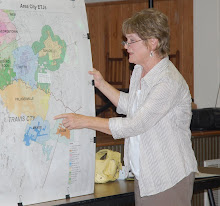
If you are in the Eastern Williamson/Travis area, another project to be aware of is the new water pipeline of Cross County Water Supply Corp. This project was covered by the Statesman on November 10: “Pipeline nearing approval to deliver water to Manor area—Project is part of race to bring water for development near Texas 130.”
http://www.statesman.com/search/content/news/stories/local/2009/11/10/1110travispipe.html
At the time this article was written, approval by the Travis County commissioners had not yet been secured, but they have since approved the project. Up to $40 million in tax-exempt bonds would be used to build a 52-mile water pipeline from Burleson County through Lee and Williamson counties to the Eastern Travis County area. Please click on the link to the article to see a map.
The Statesman notes that the project “is part of a lucrative race to serve the semirural area around Texas 130. . . [T]he transformation of the land into subdivisions and shopping centers is contingent on the shipment of water, and whoever delivers it could profit handsomely.”
Cross County is set up as a non-profit. However, behind Cross County are for-profit entities hoping to “profit handsomely” on the backs of rural property owners. The Statesman says, “Cross County counts as its customer Blue Water Systems, run by Austin real estate investor Ross Cummings, which has developed wells in Burleson County, said Pat Reilly, a director of Cross County. Blue Water, in turn, has a deal to sell water to publicly traded Southwest Water Co., Reilly said.”
Burleson County landowners Terry and Linda Ausley have been sued by Cross County because they would not give permission for the company “to perform topographical, environmental and geotechnical surveys on their land as a prelude to acquiring an easement for the water pipeline.”
The Ausleys have countersued, saying that Cross County “was formed . . . as a Texas nonprofit corporation for the sole purpose of fraudulently providing a mechanism for obtaining easements below market rate via threat of condemnation for purposes of securing a pipeline location . . .”
Fraud is already connected with this project. The Statesman notes, “The water would come from groundwater leases in Burleson County originally acquired by Metropolitan Water Co., whose president and founder is William Scott Carlson. In 2004, Cummings put up $1 million to cover Carlson's bail after he was jailed for violating the terms of his probation in a fraud case.”
Showing posts with label property rights. Show all posts
Showing posts with label property rights. Show all posts
Tuesday, November 17, 2009


Sunday, November 8, 2009
Prop 11 passes overwhelmingly--analysis from Corridor Watch
Thanks to Linda and David Stall for all their work against the Corridor for many years and for their recent analysis of the passage of Prop 11. As they point out, Prop 11, with more protection against eminent domain, passed by the largest margin of any proposition on the ballot, with a four to one margin. Over 80 percent of the voters were for Prop 11.
Corridor Watch says:
"This vote provides Texas property owners greater protection from the kind of eminent domain abuse opportunities created by the United States Supreme Court ruling in Kelo vs. City of New London. It makes it harder for the state to expand the number of entities that can exercise eminent domain power. It limits excessive use of eminent domain in the name of eliminating urban blight. And, most importantly it sends a strong message to the Governor and Legislature that Texans take private property rights very seriously.
"With Proposition 11 passed, additional protections are still required to fully protect private property rights. The legislature needs to revisit the kind of protections that would have been created under House Bill 2006 as introduced, overwhelmingly passed and vetoed by Governor Perry in 2007. Property owners deserve full and just compensation for property seized by the government. Property owners also deserve compensation for diminished access that results from the use of eminent domain.
"In vetoing HB-2006 in 2007 Governor Perry said that it would cost the state too much. We believe that seizing private property should be hard, should be expensive, and should only be used as the last resort.
"Projects like the Trans Texas Corridor (TTC) need to stand on their own merits and not on the state's ability to take land away from private owners at costs well below market value. And most importantly, state power should never be used to seize private property for the purpose of generating state revenue, whether it's by lease, sale, or toll concession.
"The TTC was always about generating revenue first and providing transportation second. Proposition 11 is another step forward in our effort to ensure that the threat on private property created by the TTC (no matter what new name it may be given) never returns."
Corridor Watch and other property rights advocates like the Texas Farm Bureau are ready to come back at the beginning of next session to try to get additional eminent domain protections. The passage of Prop 11 makes this job easier than it would have been if Prop 11 had not passed. If the voters had not passed Prop 11, it would have sent a message to our elected officials that the people were not really that interested in getting more protection against eminent domain.
Corridor Watch says:
"This vote provides Texas property owners greater protection from the kind of eminent domain abuse opportunities created by the United States Supreme Court ruling in Kelo vs. City of New London. It makes it harder for the state to expand the number of entities that can exercise eminent domain power. It limits excessive use of eminent domain in the name of eliminating urban blight. And, most importantly it sends a strong message to the Governor and Legislature that Texans take private property rights very seriously.
"With Proposition 11 passed, additional protections are still required to fully protect private property rights. The legislature needs to revisit the kind of protections that would have been created under House Bill 2006 as introduced, overwhelmingly passed and vetoed by Governor Perry in 2007. Property owners deserve full and just compensation for property seized by the government. Property owners also deserve compensation for diminished access that results from the use of eminent domain.
"In vetoing HB-2006 in 2007 Governor Perry said that it would cost the state too much. We believe that seizing private property should be hard, should be expensive, and should only be used as the last resort.
"Projects like the Trans Texas Corridor (TTC) need to stand on their own merits and not on the state's ability to take land away from private owners at costs well below market value. And most importantly, state power should never be used to seize private property for the purpose of generating state revenue, whether it's by lease, sale, or toll concession.
"The TTC was always about generating revenue first and providing transportation second. Proposition 11 is another step forward in our effort to ensure that the threat on private property created by the TTC (no matter what new name it may be given) never returns."
Corridor Watch and other property rights advocates like the Texas Farm Bureau are ready to come back at the beginning of next session to try to get additional eminent domain protections. The passage of Prop 11 makes this job easier than it would have been if Prop 11 had not passed. If the voters had not passed Prop 11, it would have sent a message to our elected officials that the people were not really that interested in getting more protection against eminent domain.
Tuesday, October 27, 2009
Texas Farm Bureau--FOR Prop. 11
Regan Beck, associate legislative director of the Texas Farm Bureau, spoke to the Coupland Civic Organization at their October 26 meeting. He covered the issues of interest to farmers, ranchers, and other rural residents during the last session of the Legislature.
Regarding trying to protect property rights, he called it “all in all, a good session, but not a great session.” The TFB’s efforts were partially successful against eminent domain. Regarding the Trans-Texas Corridor, he said, “We want to take it off the books. We were so close at the end of the session in getting this [and other things that were in HB 300, the TxDOT Sunset bill], but it fell through.”
He noted that HB 300 would have repealed the Trans-Texas Corridor. It also included diminished access protection in eminent domain actions. Since HB 300 failed to pass, the Legislature had to extend the existence of TxDOT during the special session and will have to deal with TxDOT’s Sunset process during the next regular session.
The good news—TFB is pleased with $30 million in aid that passed for rural Texans, including funds for boll weevil eradication, feral hog control, and repair for earthen flood control dams. [Ed Komandosky, secretary/treasurer of Brushy Creek Water Control and Improvement District, spoke to the last meeting of the Coupland Civic Organization about the funding and repair work on the dams in our area.]
Beck calls SB 18 “a great bill that included good faith negotiation to treat the landowner as fairly as possible, by negotiating in good faith upfront before the property is condemned.” SB 18 also included more disclosures for the property owner and a ten-year buy-back provision, whereby if the condemning entity did not use the property within ten years, the owner could buy it back for the same price he was paid for it. Unfortunately, SB 18 was one of the bills left unpassed when time ran out at the end of the session.
Much of the problems that property owners have with condemning entities are not even with governments, but with others who have been given the power of condemnation, such as pipeline companies. There was a provision that the comptroller would be notified of all entities that have power to condemn. Then, if an entity does not sign up with comptroller, it loses its condemnation power. Unfortunately, this was not passed.
Beck said, “HJR 14 was passed and is Proposition 11 on the ballot. We still need to do more on eminent domain, but Prop 11 helps.” When asked if the TFB was prepared to start early next session to get more eminent domain protections, he said yes. He noted that this last session, it took too long to get more protections through the Senate--too long to get some Senators on board--and then the legislation failed in the last-minute gridlock. In this coming session, Beck hopes that the Senators already will be prepared to support protections, so that legislation can move through faster.
Regarding trying to protect property rights, he called it “all in all, a good session, but not a great session.” The TFB’s efforts were partially successful against eminent domain. Regarding the Trans-Texas Corridor, he said, “We want to take it off the books. We were so close at the end of the session in getting this [and other things that were in HB 300, the TxDOT Sunset bill], but it fell through.”
He noted that HB 300 would have repealed the Trans-Texas Corridor. It also included diminished access protection in eminent domain actions. Since HB 300 failed to pass, the Legislature had to extend the existence of TxDOT during the special session and will have to deal with TxDOT’s Sunset process during the next regular session.
The good news—TFB is pleased with $30 million in aid that passed for rural Texans, including funds for boll weevil eradication, feral hog control, and repair for earthen flood control dams. [Ed Komandosky, secretary/treasurer of Brushy Creek Water Control and Improvement District, spoke to the last meeting of the Coupland Civic Organization about the funding and repair work on the dams in our area.]
Beck calls SB 18 “a great bill that included good faith negotiation to treat the landowner as fairly as possible, by negotiating in good faith upfront before the property is condemned.” SB 18 also included more disclosures for the property owner and a ten-year buy-back provision, whereby if the condemning entity did not use the property within ten years, the owner could buy it back for the same price he was paid for it. Unfortunately, SB 18 was one of the bills left unpassed when time ran out at the end of the session.
Much of the problems that property owners have with condemning entities are not even with governments, but with others who have been given the power of condemnation, such as pipeline companies. There was a provision that the comptroller would be notified of all entities that have power to condemn. Then, if an entity does not sign up with comptroller, it loses its condemnation power. Unfortunately, this was not passed.
Beck said, “HJR 14 was passed and is Proposition 11 on the ballot. We still need to do more on eminent domain, but Prop 11 helps.” When asked if the TFB was prepared to start early next session to get more eminent domain protections, he said yes. He noted that this last session, it took too long to get more protections through the Senate--too long to get some Senators on board--and then the legislation failed in the last-minute gridlock. In this coming session, Beck hopes that the Senators already will be prepared to support protections, so that legislation can move through faster.
Thursday, April 16, 2009
Rick Perry talks secession--national media goes gaga
Gov. 39% is NOT for the citizen against big government--he's on big government's side
Hard to know whether to laugh or cry, seeing all the coverage that Gov. 39% has gotten as being a small-government conservative (whether or not this is viewed favorably) because of his remarks at April 15 Tea Parties, resulting in appearances on national radio and TV and favorable comments on widely read blogs. He has been a major story, “Rick Perry: Tea party darling,” with a picture, no less, on politico.com.
Texans know that mentioning “secession”—in jest or seriously--is not that rare in the Lone Star State, given our unique journey from sovereign nation to statehood and the discussion over the rights given to Texas in exchange for becoming a state—whether Texas can just up and leave or can divide into several states.
However, the rest of the country evidently has never heard about this, so Perry really got their attention by mentioning the “s” word. Unfortunately, the rest of the country has not paid that much attention to the details of Perry’s governance, so took him at his word when he said things like, “shrink the government; reread the Constitution.”
They have never heard of Perry’s “vision” as he says, and “nightmare” as residents say, of the Trans-Texas Corridor (TTC), a network of quarter-mile wide road lanes, rail lines, and utility-pipeline zones. The TTC would wrest 600,000 acres from Texas landowners through eminent domain and turn their private property over to Cintra, a Spanish corporation. Perry rammed his TTC authorization through the Legislature in 2003 before legislators had time to read it.
When Perry says, ungrammatically, “But Texas is a very unique place, and we’re a pretty independent lot to boot,” and when he decries government “intrusion into the lives of our citizens,” the rest of the country doesn’t know that HE has been the enemy of Texas landowners—trying to take over citizens’ land unnecessarily to benefit the road lobby and foreign corporations. HE hasn’t been fighting for Texans; Texans have been fighting HIM.
In fact, the TTC/toll issue has become a defining difference in the 2010 gubernatorial race between Perry and Sen. Kay Bailey Hutchison, who has asked, “Are you concerned that our state government ignores private property rights and property owners in a quest to cover our state with massive toll roads?” Up until now, KBH has led Perry in most polls. This is at least one reason that Perry tried to perform the old trick—and apparently somewhat successfully—of seeing the Tea Party parade starting and running around to get in front of it.
Additionally, this became another opportunity for Perry to test the national waters, as he has done from time to time. His camp probably realizes that the country is not ready yet for another president from Texas, but they may think that if he starts rising now through the ranks of possible presidential candidates, he may be prominent in 2012 and be positioned for 2016.
When I hear Gov. 39%, I hear arrogance (“Why don't you let us get on down the road,” “Mofo,” etc.) and phoniness. Will the rest of the country hear that?
Perry is not an advocate for the small businesses, the farm and ranch families—the people who are the backbone of the nation. He is an advocate for the corporative state where large private concerns are able to take over and use the power of government to oppress the individual and take his private property. Will the rest of the country realize that?
Hard to know whether to laugh or cry, seeing all the coverage that Gov. 39% has gotten as being a small-government conservative (whether or not this is viewed favorably) because of his remarks at April 15 Tea Parties, resulting in appearances on national radio and TV and favorable comments on widely read blogs. He has been a major story, “Rick Perry: Tea party darling,” with a picture, no less, on politico.com.
Texans know that mentioning “secession”—in jest or seriously--is not that rare in the Lone Star State, given our unique journey from sovereign nation to statehood and the discussion over the rights given to Texas in exchange for becoming a state—whether Texas can just up and leave or can divide into several states.
However, the rest of the country evidently has never heard about this, so Perry really got their attention by mentioning the “s” word. Unfortunately, the rest of the country has not paid that much attention to the details of Perry’s governance, so took him at his word when he said things like, “shrink the government; reread the Constitution.”
They have never heard of Perry’s “vision” as he says, and “nightmare” as residents say, of the Trans-Texas Corridor (TTC), a network of quarter-mile wide road lanes, rail lines, and utility-pipeline zones. The TTC would wrest 600,000 acres from Texas landowners through eminent domain and turn their private property over to Cintra, a Spanish corporation. Perry rammed his TTC authorization through the Legislature in 2003 before legislators had time to read it.
When Perry says, ungrammatically, “But Texas is a very unique place, and we’re a pretty independent lot to boot,” and when he decries government “intrusion into the lives of our citizens,” the rest of the country doesn’t know that HE has been the enemy of Texas landowners—trying to take over citizens’ land unnecessarily to benefit the road lobby and foreign corporations. HE hasn’t been fighting for Texans; Texans have been fighting HIM.
In fact, the TTC/toll issue has become a defining difference in the 2010 gubernatorial race between Perry and Sen. Kay Bailey Hutchison, who has asked, “Are you concerned that our state government ignores private property rights and property owners in a quest to cover our state with massive toll roads?” Up until now, KBH has led Perry in most polls. This is at least one reason that Perry tried to perform the old trick—and apparently somewhat successfully—of seeing the Tea Party parade starting and running around to get in front of it.
Additionally, this became another opportunity for Perry to test the national waters, as he has done from time to time. His camp probably realizes that the country is not ready yet for another president from Texas, but they may think that if he starts rising now through the ranks of possible presidential candidates, he may be prominent in 2012 and be positioned for 2016.
When I hear Gov. 39%, I hear arrogance (“Why don't you let us get on down the road,” “Mofo,” etc.) and phoniness. Will the rest of the country hear that?
Perry is not an advocate for the small businesses, the farm and ranch families—the people who are the backbone of the nation. He is an advocate for the corporative state where large private concerns are able to take over and use the power of government to oppress the individual and take his private property. Will the rest of the country realize that?
Saturday, March 21, 2009
Dan Byfield, national property rights advocate, to speak in Coupland March 30
In the comment to yesterday's post, Eminent domain bill set for hearing March 25, Chris writes about the problems encountered by property owners with issues other than condemnation for transportation, such as energy and right-of-way. The Coupland Civic Organization is hosting a national property rights advocate on Monday, March 30, whose organization is involved in all these issues.
Dan Byfield, president of the American Land Foundation, a national property rights organization, will speak to the Coupland Civic Organization on Monday, March 30, in the Fellowship Hall of St. Peter’s Church of Coupland. The Coupland Civic Organization will host a spaghetti supper at 6:30 p.m.; the program will begin at 7 p.m.
Byfield will discuss the “391 Commissions” that he has formed in Texas to fight projects like the Trans-Texas Corridor. He says, “The American Land Foundation and Stewards of the Range have joined efforts to teach local communities how to fight for and protect private property through a strategy known as ‘Coordination.’ Utilizing federal and state land use statutes, Coordination gives local units of government the power to bring government regulatory agencies to their table.”
These agencies are required by law to “coordinate,” meaning that they have to give notice of any plans or projects they are considering to the local unit of government, such as a “391 Commission.” The agency must take local plans and desires into account when making its plans. “The strongest aspect of Coordination,” Byfield explains, “is the government agencies have to make their plans, as closely as possible, consistent with the local plans.”
The first “391 Commission” is the Eastern Central Texas Sub-Regional Planning Commission in Bell County, which was founded in 2007 to fight the Trans-Texas Corridor. Byfield says, “In 2008, we went to over 20 locations utilizing Coordination, with nine in Texas. This year, we expect to get to over 40 communities implementing Coordination nationwide for every type of issue, including Endangered Species Act listings, water rights, zoning, transportation, conservation easements, oil and gas exploration, and dozens of other land use issues.”
In addition to discussing helping local communities fight for their property rights, Byfield will also speak on related legislative issues, such as eminent domain.
Dan Byfield has worked on property rights, water, and natural resource issues as a legislative staff member. He has lobbied on behalf of agriculture for the Texas Farm Bureau. He did legislative work on property rights matters in New Mexico, Texas, and Washington for the Farm Credit Bank of Texas. In 1993, he formed the American Land Foundation and serves as its president. The American Land Foundation assists landowners and other property rights organizations nationwide.
Dan Byfield, president of the American Land Foundation, a national property rights organization, will speak to the Coupland Civic Organization on Monday, March 30, in the Fellowship Hall of St. Peter’s Church of Coupland. The Coupland Civic Organization will host a spaghetti supper at 6:30 p.m.; the program will begin at 7 p.m.
Byfield will discuss the “391 Commissions” that he has formed in Texas to fight projects like the Trans-Texas Corridor. He says, “The American Land Foundation and Stewards of the Range have joined efforts to teach local communities how to fight for and protect private property through a strategy known as ‘Coordination.’ Utilizing federal and state land use statutes, Coordination gives local units of government the power to bring government regulatory agencies to their table.”
These agencies are required by law to “coordinate,” meaning that they have to give notice of any plans or projects they are considering to the local unit of government, such as a “391 Commission.” The agency must take local plans and desires into account when making its plans. “The strongest aspect of Coordination,” Byfield explains, “is the government agencies have to make their plans, as closely as possible, consistent with the local plans.”
The first “391 Commission” is the Eastern Central Texas Sub-Regional Planning Commission in Bell County, which was founded in 2007 to fight the Trans-Texas Corridor. Byfield says, “In 2008, we went to over 20 locations utilizing Coordination, with nine in Texas. This year, we expect to get to over 40 communities implementing Coordination nationwide for every type of issue, including Endangered Species Act listings, water rights, zoning, transportation, conservation easements, oil and gas exploration, and dozens of other land use issues.”
In addition to discussing helping local communities fight for their property rights, Byfield will also speak on related legislative issues, such as eminent domain.
Dan Byfield has worked on property rights, water, and natural resource issues as a legislative staff member. He has lobbied on behalf of agriculture for the Texas Farm Bureau. He did legislative work on property rights matters in New Mexico, Texas, and Washington for the Farm Credit Bank of Texas. In 1993, he formed the American Land Foundation and serves as its president. The American Land Foundation assists landowners and other property rights organizations nationwide.
Subscribe to:
Posts (Atom)